
Country Guides
Why Perth for South Africans: The City's Quiet SA Community, Mining Corridor, and What "Familiar" Actually Means
Perth has the highest concentration of South Africans of any major Australian city. Time zone, climate and the mining corridor make it the city that feels closest to home — what to weigh before you settle there.
Migration rules change regularly. Treat this article as a policy snapshot and confirm current requirements with a licensed advisor before relying on it.
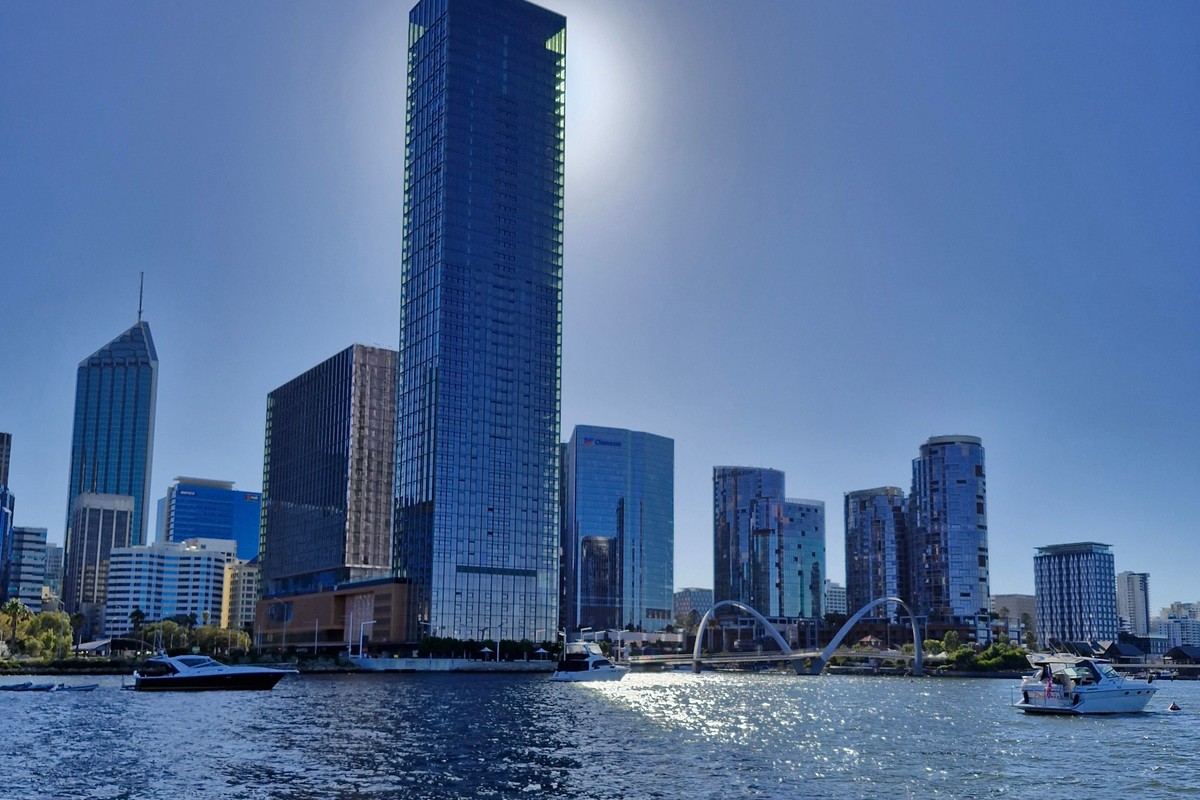
Photo: Photo by Cheryl Waters on Pexels (https://www.pexels.com/photo/perth-skyline-with-sunlit-high-rise-buildings-31711386/)
In short: Perth has the highest concentration of South Africans of any major Australian city — close to 1.8 per cent of the metropolitan population at the 2021 Census, roughly double Sydney’s share — but the community is a quiet network organised around school catchments and the southern-river and south-eastern suburbs rather than a visible precinct. Its Mediterranean climate, Indian Ocean coastline, and SA food and sporting culture make it the Australian city that reads as closest to home for families from Cape Town or Johannesburg. The work economy is unusually accommodating: CBD professional services, state-system healthcare and education, and a Pilbara mining corridor worked on FIFO rotations out of Perth Airport. The city question comes first; the visa pathway follows once Perth-fits is settled.
Annelize Botha stands outside a Mount Pleasant supermarket on her family’s first Saturday in Perth holding a jar of Mrs Ball’s Chutney. The 491 grant came through six weeks earlier than the household goods were packed for. The school year started a month ago. Three different SA-Perth contacts have told her the South African community in Perth is large, established, and easy to find. The first morning produces no precinct, no signposted street, no Afrikaans bookshop, no Little Joburg. By the second Saturday, through a school-gate introduction at a primary school her children have not yet started at, she is at a backyard braai in Applecross with four families, three SA cities represented, the chutney in the marinade and the cricket on a kitchen screen.
The SA community in Perth is not a precinct. It is a network organised around schools, suburbs, and Saturday afternoons. The reader who has typed “Perth for South Africans” into a search bar deserves the honest version of that texture before deciding, not the precinct version the search results promise.
This piece is about the city, not the visa. The migration mechanics matter, and we cover them elsewhere. The question that comes first is whether Perth fits an SA family, on its own terms, before a single form is opened.
How big is the South African community in Perth, really?
Perth has the highest concentration of South Africans of any major Australian city. At the 2021 Census, about 38,800 Greater Perth residents were born in South Africa — roughly 1.8 per cent of the metropolitan population, more than double the share in Greater Sydney (0.76 per cent) or Greater Melbourne. In raw numbers Greater Sydney’s South African-born population is marginally larger (about 39,600), but nowhere in Australia do South Africans make up as large a share of a capital as they do in Perth, and that density is what an arriving family actually feels on the ground. The densest concentration sits in the southern river suburbs and the south-eastern corridor.
What the headcount does not tell you is the shape of the community. There is no Little Joburg in Perth. There is no equivalent of a Bondi-for-South-Africans precinct visible to a new arrival on day three. The community is large in numbers and quiet in visibility because it organises around schools, sporting clubs, churches, and the southern-suburb backyard, not around a high street.
For an SA family arriving in the expectation of a precinct, this is the gap that produces a difficult second week. The community is there. It is reached through school gates and weekend invitations, not through a Saturday-morning walk down a named street.
Which suburbs do SA families cluster in, and why?
The southern river corridor is where the community is densest. Mount Pleasant, Applecross, Como, Booragoon, and the Rossmoyne-Shelley belt carry the highest SA-heritage concentrations on the river side. The south-eastern corridor (Willetton, Canning Vale, Riverton, Parkwood) carries the second densest cluster, with newer arrivals more often landing here than on the riverfront because the entry-price point is materially lower.
Three drivers shape the pattern. The first is public-school catchments. Applecross Senior High, Rossmoyne Senior High, and Willetton Senior High sit inside catchments that have carried SA-heritage cohorts for two decades, and the catchment-area pricing premium on housing follows the school reputation. The second is proximity to professional employment, with the riverfront suburbs offering a 15-to-20-minute commute into the Perth CBD for the legal, financial, engineering, and corporate-services principals. The third is the Indian Ocean coastline at Fremantle, Cottesloe, and the Marmion-to-Mullaloo stretch, which an SA family from Cape Town reads as familiar in a way that the Sydney or Melbourne coast does not match.
The pattern is not a rule. SA families settle across Perth, from the northern beach suburbs of Hillarys and Sorrento down to the southern coastal belt at Mandurah. The southern-river concentration is the gravity well, not the boundary.
What about schools?
This is the question most SA-Perth arriving families underestimate. Western Australia operates a catchment-based public-school enrolment system. Each public school holds a defined local-intake area, and a child living inside the boundary has guaranteed enrolment at that school. A child living outside the boundary applies under out-of-area criteria, with no guarantee .
Three practical consequences follow. House prices inside the catchments of the higher-demand public schools (Applecross, Rossmoyne, Willetton, Shenton College on the western side) sit at a measurable premium against equivalent housing one street outside. The catchment lookup is a Department of Education tool, not a real-estate-listing footnote, and we have seen SA families commit to a lease or purchase on the assumption of a catchment that does not hold up to the lookup.
The independent and private sector is the second route. The Anglican, Catholic, and independent schools across Perth operate enrolment-by-application without catchment binding, with waitlists that for the most-sought schools run into years. An SA family with a December-grant 491 and a February school-year start does not have time to navigate a three-year waitlist, which means the public catchment route is usually the live option for the first year.
The SA-heritage cohort question matters in practice. A child entering year five at a Rossmoyne or Applecross primary will likely find three or four other children with SA accents in the class. A child entering year ten at a Willetton or Shenton high school will find the same, with the SA-heritage cohort already part of the social fabric. For a teenager carrying the dislocation of a mid-school move, the cohort-already-there factor is not a minor comfort.
Where is the work, for the SA principal arriving with a credential?
Perth is a four-economy city for the SA-arriving principal. The Perth CBD carries the legal, financial-services, accounting, and corporate-services cluster, with a working week that runs in shape and pace closer to Cape Town than to Johannesburg. The healthcare and education sectors run on the state-system rhythm and absorb SA-trained nurses, allied health practitioners, GPs (subject to AHPRA pathway), and teachers in volume.
The third economy is the resources sector. Perth is the operational headquarters for the WA mining and oil-and-gas industry, and the Pilbara mining corridor (Karratha, Newman, Tom Price, Port Hedland) operates on a fly-in fly-out basis from Perth Airport . Common rotations sit at two weeks on and one week off, or eight days on and six days off, depending on operator and role. SA mining-sector principals (mining engineers, structural and civil engineers, geologists, drill-and-blast specialists, operational managers) cluster in the FIFO pattern with the family base anchored in Perth.
The fourth economy is construction and property services, which absorbs the SA tradespeople and project managers in stable volume across the metropolitan growth corridors. For an SA family arriving with a principal earner on the resources side and a partner earner in healthcare, education, or professional services, the city-economy mix is structurally accommodating in a way that no other Australian capital matches at the same scale.
What does “familiar but different” actually look like in daily life?
The cultural overlap is real and partial. The climate runs on a Mediterranean pattern with hot dry summers and mild wet winters, closer to Cape Town than to any other Australian city. The Indian Ocean coastline from Fremantle north to Hillarys carries beaches an SA family reads as immediately recognisable. The cricket and rugby calendar holds the SA sporting week together in Perth in a way it does not in Melbourne or Hobart.
The food infrastructure is sufficient. Biltong shops and SA-product importers cluster in Como, Willetton, and the south-eastern corridor. The major supermarket chains carry Mrs Ball’s Chutney, Ouma Rusks, and Five Roses tea on shelf, not as specialty stock but as standard product, because the demand is there. Afrikaans-medium and English-medium church services run on Sunday rosters across the southern river and south-eastern suburbs.
The differences are also real. Perth is the most geographically isolated capital city of its size in the world, with the eastern Australian cities a four-to-five-hour flight away. The cost-of-living question runs higher than Johannesburg or Pretoria on housing, healthcare, and schooling, and lower on personal security, fuel, and grocery essentials. The pace of the city is slower than Johannesburg and closer to Cape Town, which suits some SA families and frustrates others in the first year.
The migration mechanics are a different conversation. Perth is classified as a designated regional area for Subclass 491 purposes under the current Department of Home Affairs postcode instrument, which surprises most SA applicants because Perth is a state capital with a metropolitan population over two million . The work of converting a Perth-fits decision into a visa pathway, an occupation-list check, a state-nomination route, and a 491-to-191 conversion plan needs a licensed agent reading the current instrument, not a search-engine result or an AI tool working from stale training data.
If Perth fits, the eligibility check at /eligibility/ is the next step. It gives you a current read on which visa pathway your occupation opens, whether Western Australia is nominating it this cycle, and what the realistic timeline looks like from where your family sits today.